Building a Resilient Portfolio

In today’s financial environment, uncertainty is no longer occasional, it is constant. Investors are navigating inflationary pressures, shifting interest rates, currency volatility, and global economic disruptions that can affect markets in unpredictable ways. In such an environment, the focus is no longer just on returns, but on how well a portfolio can withstand shocks and still stay on track. This is where the idea of a resilient portfolio becomes very important.
A resilient portfolio is one that is intentionally structured to absorb market fluctuations without losing sight of long term objectives. It is not about avoiding risk entirely, but about managing it in a way that allows growth while reducing the impact of volatility. It reflects discipline, strategy, and a clear understanding of financial goals.
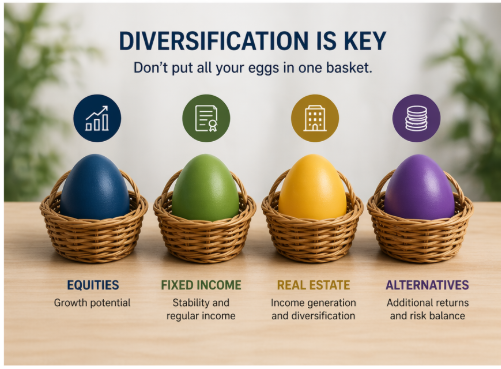
One of the most important building blocks of resilience is diversification. By spreading investments across multiple asset classes such as equities, fixed income instruments, money market products, and alternative investments, investors reduce overexposure to any single source of risk. Different asset classes respond differently to economic conditions, so when one is under pressure, another may provide stability or even growth. This balance helps smooth overall portfolio performance over time.
Closely tied to diversification is asset allocation discipline. A resilient portfolio is not built on random selection of assets, but on a deliberate allocation strategy that reflects risk appetite, investment horizon, and financial objectives. Maintaining this structure helps investors avoid overconcentration in one sector or instrument, which can expose them to unnecessary risk.
Another key pillar is consistency in investment behaviour. Market movements often trigger emotional reactions such as panic selling during downturns or overconfidence during rallies. A resilient portfolio is supported by a disciplined approach that avoids emotional decision making. Instead, it relies on strategy, research, and long term thinking.
Liquidity management is also a critical component. Investors need to ensure that part of their portfolio can be accessed when required without disrupting long term investments. Proper liquidity planning prevents forced withdrawals during unfavorable market conditions, which can lead to unnecessary losses or missed opportunities.
In addition, regular portfolio review and rebalancing play an essential role in maintaining resilience. Over time, market movements can shift the original structure of a portfolio, causing certain assets to become overweight or underweight. Periodic reviews help realign the portfolio with its intended strategy and ensure that it continues to reflect the investor’s goals and risk profile.
Finally, resilience is strengthened by a long term mindset. Markets will always experience cycles of growth and decline, but a well structured portfolio is designed to remain steady through these cycles. Investors who focus on long term outcomes rather than short term fluctuations are better positioned to achieve sustainable financial success.
At its core, building a resilient portfolio is about combining structure with discipline, and strategy with patience. It is about preparing for uncertainty while staying committed to long term financial goals.