Nigeria Enacts Landmark Insurance Reform to Boost Transparency, Resilience, and Investor Confidence
Global Macro Highlights
U.S. Trade Deficit Shrinks to $60.2bn in June on Steep Drop in Imports
The U.S. Census Bureau and the Bureau of Economic Analysis reported that the country’s goods and services trade deficit narrowed sharply in June 2025, coming in at USD60.2bn, down from USD71.7bn in May 2025. The improvement was primarily driven by a substantial drop in imports, which fell by USD12.8bn to USD337.5bn, compared to USD350.3bn in May 2025. Exports, on the other hand, saw only a marginal decline, slipping to USD277.3bn from USD278.6bn the previous month. The goods deficit narrowed to USD85.90bn, while the services surplus rose slightly by USD100.0mn to USD25.7bn. The contraction in the overall trade deficit was largely attributed to the decline in imports of consumer goods, pharmaceuticals, automobiles, and crude oil, which were particularly affected by the implementation of new tariffs introduced by the Trump administration during the month.
BoE Cuts Rates to 4.0% Amid Slowing Growth and Persistent Inflation Risks
The Bank of England (BoE) cut its benchmark interest rate to 4.0% in August 2025, from 4.3% in July 2025, marking its fifth rate cut since August 2024. The decision came after a rare second vote broke a 4–4 deadlock, underscoring the tension between persistent inflation risks which was up to 3.6% YoY in June 2025 vs. 3.4% YoY previously, and economic weakness as growth rate dropped to 1.3% YoY in Q1:2025 vs 1.5% YoY in Q4:2024. Lower rates should ease borrowing costs, support consumer spending, and give a modest lift to the housing market. Further cuts could be expected this year if inflation and labour market conditions weaken, though the BoE is likely to move cautiously given volatile food and energy prices.
Russia Boosts Wheat Exports with Harvests from Occupied Ukrainian Territories
Aimed at maintaining its position as the world’s leading wheat exporter, Russia has increased grain shipments by incorporating harvests from Ukrainian territories under its control, notably Luhansk, Donetsk, Zaporizhzhia and Kherson, which supplied about 3.0% of Russia’s total grain output in 2024 despite the 14.0% it recorded due to bad weather. Wheat output from these areas in 2025 is projected at 1.00 Metric Tonnnes (MT), valued at USD230.0mn, up from 500,000 tonnes last year.
In the short-term, this move is expected to boost Russia’s revenue and export volumes which the USDA estimated to be 45,000MT in the 2025/2026 season.
Ukraine’s agricultural sector, which is responsible for a significant share of its GDP and export income, is being severely undermined. Losing control over fertile lands and harvests limits Ukraine’s foreign exchange earnings and weakens its position in global grain markets.
Ghana’s Inflation Drops to 12.1%, Opening Door for Possible Rate Cuts
Ghana’s inflation rate fell to 12.1% in July 2025 from 13.7% in June, its seventh consecutive monthly decline and the lowest since October 2021. The slowdown was led by a drop in food inflation to 15.1% and a sharper fall in non-food inflation to 9.5%. Lower food prices likely reflect improved harvests, fewer supply chain disruptions, and relative currency stability, while the non-food decline points to easing cost pressures in energy, transport, and other core sectors.
We expect that if the disinflation trend continues, supported by a stable cedi and favorable global commodity prices, we anticipate the Bank of Ghana could cut policy rates by 50–100bps before the year-end 2025, a move that could boost business sentiment, spur household spending, and support GDP growth into 2026
Global Equities Market
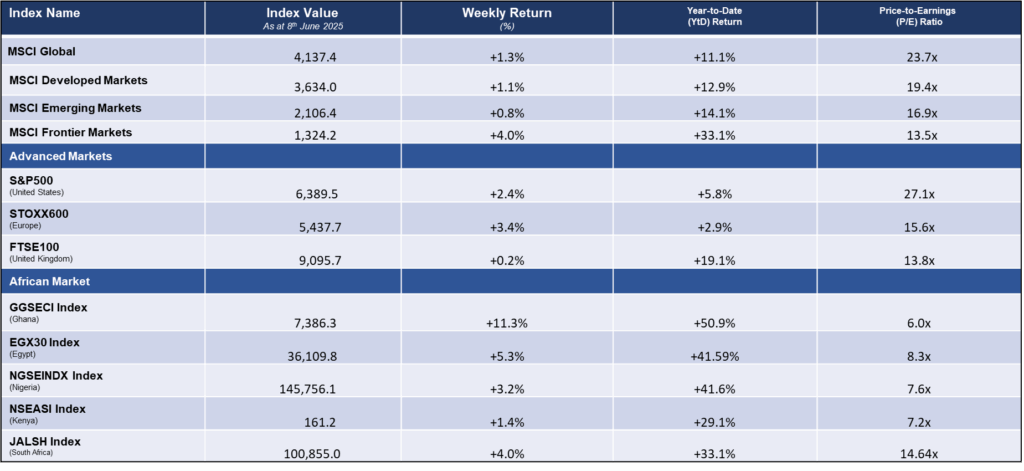
Weekly Performance of Major Global Indices
Domestic Events
Nigeria Enacts Landmark Insurance Reform to Boost Transparency, Resilience, and Investor Confidence
During the week, President Tinubu assented to the Nigerian Insurance Industry Reform bill, 2025. This Act introduced a comprehensive regulatory and supervisory framework for all insurance and reinsurance operations in the country, positioning the sector for greater transparency, resilience, and long-term sustainability. It empowers the National Insurance Commission (NAICOM) with broader oversight capabilities and sets clearer standards around governance, capital adequacy, solvency margins, and market conduct. In addition, this development is likely to have a positive impact on larger and well- capitalized firms in the industry to comply with the new regime. However, smaller operators could face increased regulatory pressure, potentially resulting in market consolidation. Overall, the reform is expected to boost investor confidence, attract new entrants, particularly foreign investors and enhance consumer trust through stronger policyholder protection mechanisms.
Nigeria’s Capital Inflows Jump 67% YoY in Q1 2025, Driven by Surge in Portfolio Investments
According to the National Bureau of Statistics (NBS), capital importation into Nigeria rose by 67.1%YoY in Q1:2025 to USD5.6bn (vs. USD3.4bn in Q1:2024), also reflecting a 10.9% QoQ increase from USD5.09bn in Q4:2024. The surge was heavily driven by portfolio investments, which accounted for 92.3% (USD5.2bn) of the total inflows, underscoring renewed foreign appetite for Nigerian equities and fixed-income instruments following improved macroeconomic reforms and attractive yields. In contrast, Foreign Direct Investment (FDI) remained subdued at USD126.0mn (2.2% of total inflows), reflecting ongoing investor caution towards long-term commitments. By sector, the banking sector led with USD3.1bn (55.4%), followed by financing at USD2.1bn and production/manufacturing at USD130.0mn.
Nigeria Approves ₦1.5trn Recapitalisation of BOA to Boost Agribusiness and Drive Inclusive Growth
During the week, the President approved the recapitalisation of the Bank of Agriculture (BOA). This move will enforce a NGN1.5trn capital injection into the institution. In our view, this initiative is aimed at repositioning the BOA as a more efficient development finance institution focused on inclusive growth, as the recapitalisation will support easier access to credit facilities and capacity-building opportunities for agribusinesses across the country.
Additionally, the fiscal authority revealed that the National Agricultural Technology and Innovation Policy (NATIP) will play a major role in this transformation by promoting mechanisation, advancing digital tools, and strengthening the link between agricultural research and commercial outcomes.
Ecobank Sells Mozambique Unit to FDH Bank, Eyes Strategic Partnerships to Sustain Cross-Border Connectivity
On the corporate scene, Ecobank Transnational Incorporated (ETI) announced the divestment of its stake in Ecobank Mozambique SA (EMZ) to FDH Bank Plc of Malawi as part of a strategic goal aligned with its Growth, Transformation, and Returns strategy. EMZ, a commercial bank operating in Mozambique, will transition to FDH Bank Plc which is an institution listed on the Malawi Stock Exchange and known for its strong digital and corporate banking services. The transaction, which will be funded entirely from FDH’s retained earnings and received all necessary regulatory approvals, is not expected to disrupt EMZ’s banking operations, employees, or customer relationships. Although this indicates Ecobank’s exit from direct operations in Mozambique, the group is exploring strategic partnerships with FDH Bank to maintain cross-border connectivity through its digital ecosystem. This shows ETI’s commitment to optimizing operational efficiency while supporting financial integration and economic development across Africa.
Equities Market – Sectorial Performance
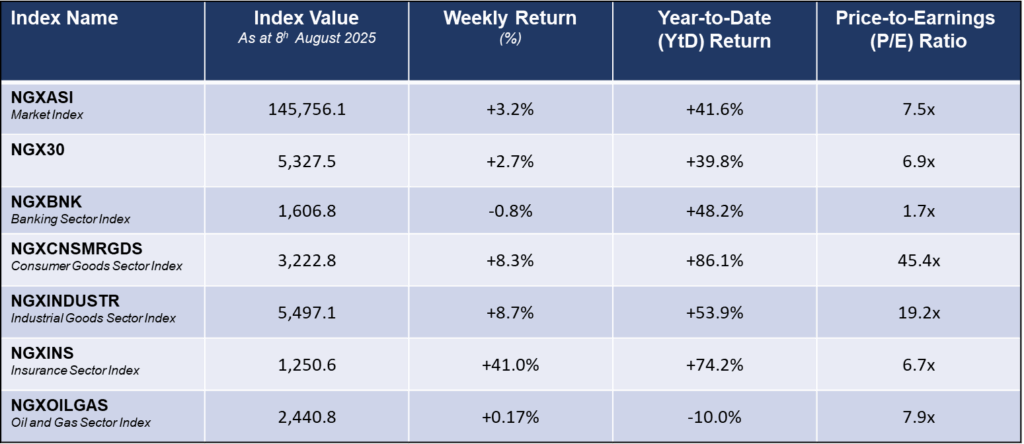
Weekly Performance of Sectorial Indices
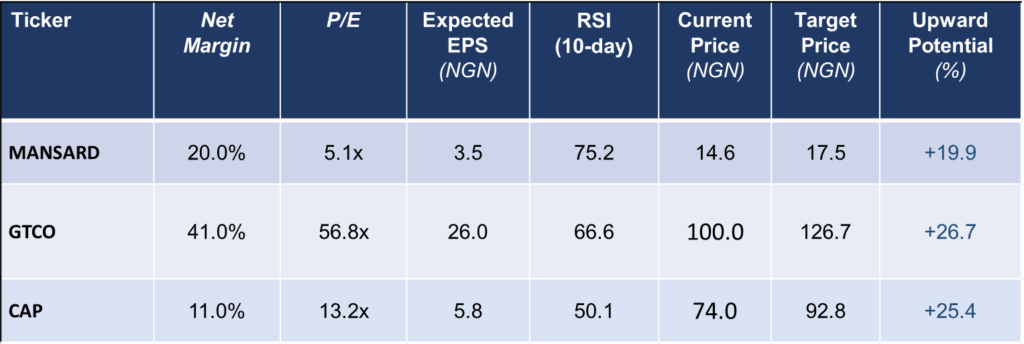
Stocks Top Picks for the Week
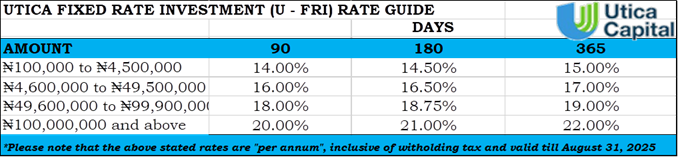
Fixed Income Opportunities for the week