Nigeria Records 11th Month of Economic Expansion Driven by Industry, Services, and Agriculture
Global Macro Highlights
UK Economy Shows Slower Growth Amid Weak Investment and Rising Costs
According to the Office for National Statistics, the UK economy expanded by 1.3% YoY in Q3:2025, slightly below 1.4% YoY in Q2:2025 as business investment slowed to 0.7% YoY, household consumption eased to 0.7% YoY, and net trade weighed on output as imports grew faster than exports. On a quarterly basis, GDP grew 0.1% QoQ (vs. 0.3% QoQ in Q2:2025), driven by a 0.5% QoQ contraction in the production sector and a 0.8% QoQ decline in manufacturing. The Services sector expanded 0.2% QoQ. Also, the economy’s unemployment rate rose to 5.0% in Q3:2025. Vacancies declined in 9 of 18 industries, led by Real Estate Activities (-20.6%); the largest volume drops came from Human Health & Social Work Activities (-10,000) and Accommodation & Food Services (-5,000), although Professional, Scientific & Technical Activities added 5,000 vacancies and Education added 4,000. Increased employer taxes and operating costs have made businesses increasingly cautious, especially given the current GDP trend. The 2024 Autumn budget introduced a lower employer NICs threshold from £9,100 to £5,000 alongside a higher tax rate of 15%, raising labour costs. Capital Gains Tax was also increased, with rates on assets like shares moving from 10% to 18% for basic-rate taxpayers and from 20% to 24% for higher-rate taxpayers. These changes have weighed on business activity and investment sentiment.
In our view, this slowdown in output and labour-market conditions could weaken firm revenues, reduce business investment, and slow household income growth, which then reduces consumption and pressures government tax revenue at a time when unemployment-related spending is rising. Consequently, business spending is likely to remain cautious, as earlier tariff pressures also contributed to higher cost pressures. As a result, we expect the UK economy to remain on a weaker growth path as domestic demand continues to soften, with the IMF projecting 1.30% real GDP growth in 2025, implying a moderate recovery as firms operate with tighter cost structures. Growth could be supported by gradual improvements in trade flows and expected monetary easing. While the Bank of England has maintained a cautious stance to balance growth with price stability, we expect a rate cut at the next meeting especially as the anticipated Autumn Budget approaches, which could include further tax increases.
U.S. Government Reopens After Record 43-Day Shutdown Amid Rising Debt Concerns
The U.S. government has reopened after a 43-day shutdown, the longest in American history, following Congress’s approval of a temporary bipartisan funding bill that extends federal operations until 30 January 2026. This reopening allows approximately 1.4mn federal workers to resume normal activities. The shutdown had wide-ranging effects, disrupting airline operations, delaying food-assistance payments, and halting federal support for small businesses. During the shutdown, the federal government borrowed USD619bn. Despite growing concerns over the expanding national debt, discussions on long-term fiscal reforms, including deficit reduction or restructuring of mandatory spending, were largely absent from the negotiations.
Looking ahead, the risk of another funding impasse remains high as the 30 January 2026 deadline approaches. We expect Congress to maintain active negotiations to find a resolution, while the Federal Reserve may hold rates at its next meeting as policymakers reassess incoming economic data delayed during the shutdown.
South Africa Narrows Inflation Target to 3% for First Time in 25 Years
South Africa has set a new inflation target of 3.0% from the previous target of 3.0%-6.0%, making it the first adjustment in 25 years. The new target will include a tolerance band of ±1.0% point. A narrower target is expected to help guide inflation expectations better, improve policy confidence, and boost competitiveness. The move is supported by recent inflation trends as headline inflation has been between 2.7% and 3.8% in 2025. September 2025 the latest inflation figure at 3.4%. By adopting a 3.0% anchor, authorities aim to consolidate disinflation gains achieved through tight monetary policy, fiscal restraint and easing global price pressures. The adoption of a 3.0% target is a decisive step toward prioritising price stability in South Africa’s policy framework. It provides a clearer benchmark for the SARB’s monetary actions. With inflation now close to the new target, the SARB is widely expected to cut interest rates next week.
Global Equities Market
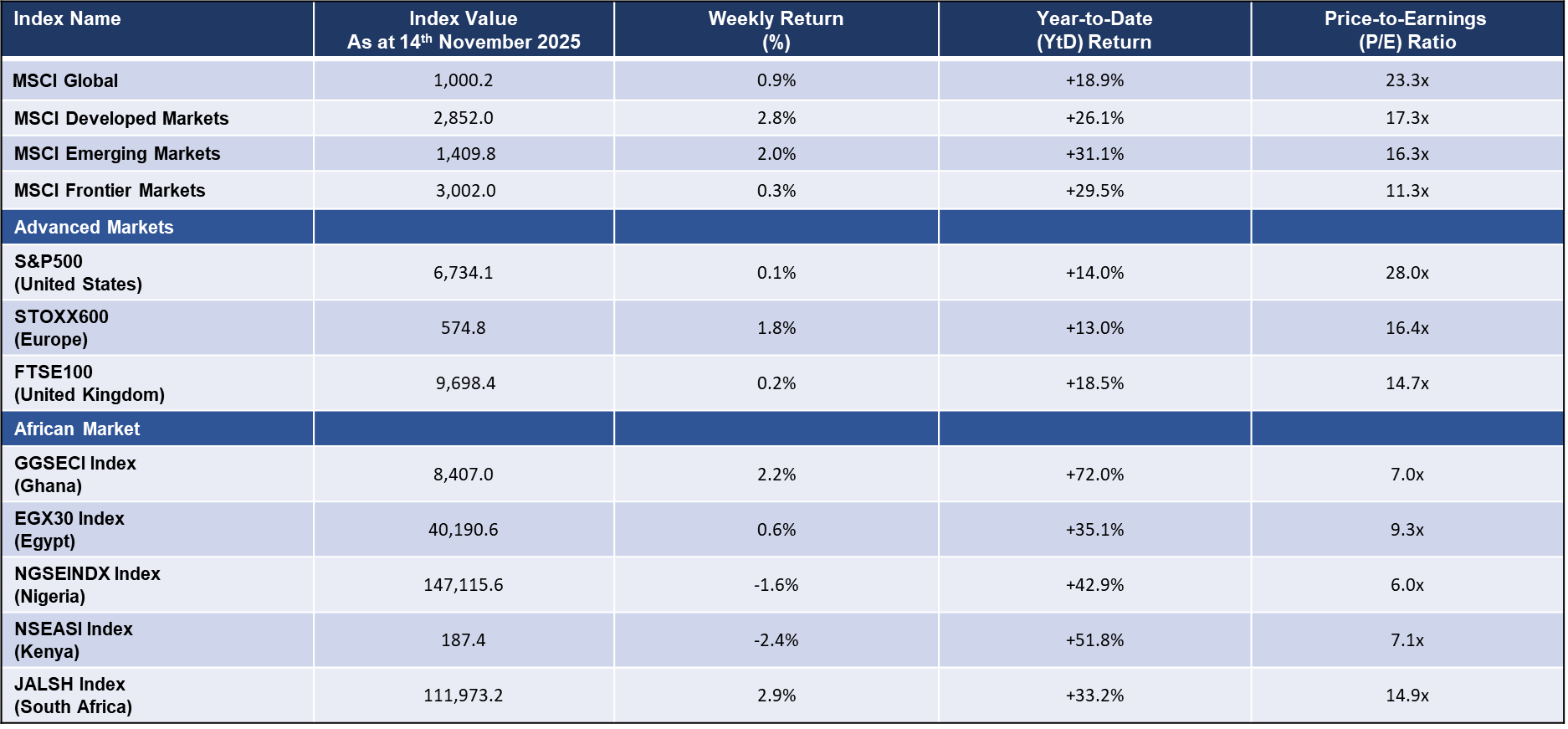
Weekly Performance of Major Global Indices
Domestic Events
Nigeria Records 11th Month of Economic Expansion Driven by Industry, Services, and Agriculture
According to the Central Bank of Nigeria (CBN) Purchasing Managers’ Index (PMI), Nigeria’s economy recorded its eleventh consecutive month of expansion in October 2025. The PMI rose to 55.4 points from 54.0 points in September, representing a +2.7% MoM increase. The expansion was broad-based, supported by Industry at 54.2 points, Services at 55.6 points and Agriculture at 55.7 points. Data shows that 25 of the 36 subsectors across these sectors recorded expansion, with Educational Services, Forestry and Printing & Related Support Activities leading at 71.9, 65.6 and 62.4 points, respectively, while 11 subsectors experienced mild contractions. The expansion points to stronger manufacturing output, steady business activity, recovering demand and favourable agricultural conditions.
We expect sector expansion to remain positive, supported by our improving macroeconomic outlook specifically improvements in inflation and exchange-rate stability. Expectations of additional rate cuts in the coming months could also encourage more borrowing for business expansion, helping to sustain growth across the sectors.
Nigeria Approves Additional NGN1.1trn Borrowing Amid Rising Debt Pressures
Nigeria’s National Assembly has approved an additional NGN1.1trn in domestic borrowing to close the financing gap in the 2025 fiscal plan. The expansion became necessary after lawmakers passed a budget with a NGN14.1trn deficit which is above the NGN12.9trn originally proposed by the executive. While the approval supports short-term fiscal stability and ensures smoother budget execution, it also reinforces the need for careful debt management. Nigeria’s public debt stood at NGN152.4trn as of June 2025 and is expected to rise with the recent USD2.4bn Eurobond issuance and the planned USD0.5bn sukuk later in the year. These additional borrowings will increase debt-service obligations, with external payments at USD932.1mn and domestic payments at NGN1.7trn in Q2:2025.
Looking ahead, Nigeria’s medium-term fiscal trajectory is likely to improve as the government accelerates revenue reforms, stabilizes and ramps up oil production, and manages the pace of expenditure growth. Without these, debt accumulation is expected to continue, which could reduce fiscal space, raise the debt-to-GDP ratio, increase debt-service-to-revenue pressures, and heighten vulnerability to global financing and interest-rate shocks.
NMDPRA Suspends 15% Fuel Import Duty to Stabilize Supply and Prices
The Nigerian Midstream and Downstream Petroleum Regulatory Authority (NMDPRA) has suspended the planned 15.0% ad-valorem import duty on Premium Motor Spirit (PMS) and Automotive Gas Oil (AGO). In its official statement, the Authority assured that there is adequate supply of petroleum products including PMS, AGO and Liquefied Petroleum Gas (LPG) from both local refineries and import channels. It also urged against panic buying or hoarding, emphasizing its close monitoring of distribution networks to maintain stable supply during the peak demand period. Given elevated inflationary pressures, the government opted to delay the policy to avoid further strain on consumers and businesses.
In our expectations, the move should help stabilize retail prices, curb inflationary pass-throughs and sustain product availability ahead of the festive season. However, it implies forgone fiscal revenue and could slow momentum toward refining self-sufficiency, as import parity pricing remains dominant. However, overall energy stability is likely to improve as local refining progresses, particularly with plans to privatize some of the non-operational refineries in the country.
Nigeria Introduces Progressive Capital Gains Tax Under 2025 Tax Reform Act
Following the signing of the new Tax Reform Bills on June 26, 2025, set to take effect from January 1, 2026, Nigeria introduced a revised Capital Gains Tax (CGT) framework as part of the 2025 Finance and Tax Reform Act. Under the new reforms, CGT becomes progressive. Individuals earning NGN800,000 and below are exempt. Individuals whose annual proceeds from asset sales do not exceed NGN150.0mn, with gains under NGN10.0mn, will also be exempt. For companies, PFAs, REITs, NGOs, or companies with turnover under NGN100.0mn and fixed assets below NGN250.0mn, exemptions remain. Companies face higher CGT ranges: (0–30%) for companies versus (0–25%) for individuals. Investors who reinvest proceeds from share sales into other listed or unlisted equity assets are also exempt, and companies undergoing reorganizations, mergers, or restructurings are also exempt. Concerns on higher tax burdens, particularly for market movers such as institutional and foreign investors, initially pressured the stock market. Clarifications from the Chairman of the Presidential Fiscal Policy and Tax Reforms Committee (FPTRC) on tax implementation helped restore calm. In our view, the 2025 Tax Reform Act is likely to broaden CGT compliance and boost revenue collection through tighter enforcement and reporting. For investors particularly short-term holders, the reforms imply lower post-tax gains, while long-term strategic investments remain attractive if gains are held over extended periods.
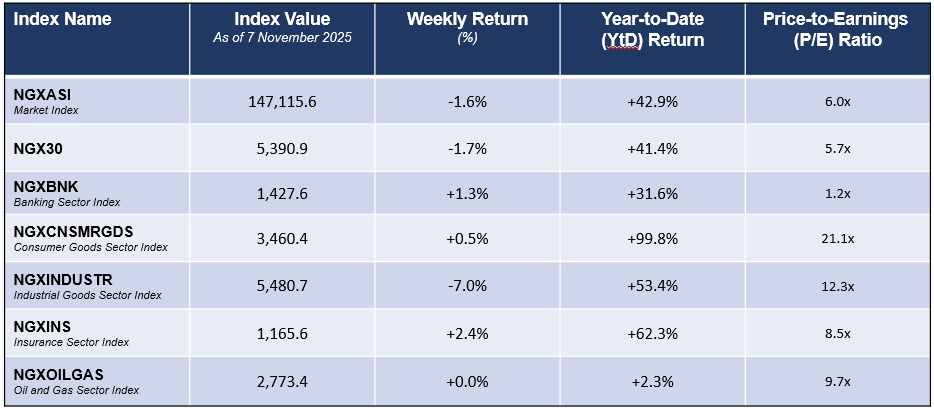
Equities Market – Sectorial Performance
Weekly Performance of Sectorial Indices
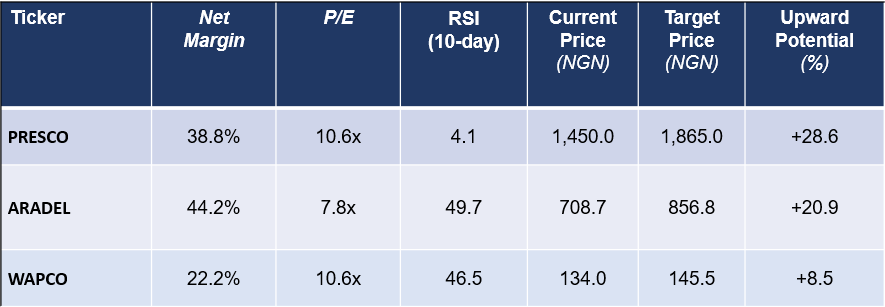
Stock Top Picks for The Week
Fixed Income Market
Fixed Income Opportunities for the week