Nigeria’s Inflation Eased to 20.1% in August, Boosted by Harvest and Stable FX
Global Macro Highlights
Fed Cuts Rates Amid Cooling Labor Market Despite Inflation Pressures
The U.S. Federal Reserve (Fed) cut its benchmark rate by 25bps. The decision came despite a mild uptick in headline inflation, which rose to 2.9% YoY in August (vs. 2.7% in July), largely driven by higher food prices (3.2% vs. 2.9%), while core inflation held steady at 3.1%. The major driver of this decision is the concern over a cooling labour market and the need to sustain economic growth. Job gains have slowed, and while unemployment remains low, it ticked up slightly to 4.3%.
We expect rates to remain steady for the rest of the year, as the Fed maintains a cautious stance amid global trade dynamics and inflation that remains above its 2.00% target.
BoE Holds Rates Steady as Sticky Inflation Balances Slowing Growth
UK headline inflation stayed at 3.8% YoY in August 2025, unchanged from July, while the monthly rate rose 0.3%, the same as a year earlier. Core inflation eased to 3.6% from 3.8%, driven by weaker services, though higher fuel and food prices partly offset the slowdown. Airfares pulled inflation lower, but restaurants, hotels, and motor fuels added upward pressure.
Against this backdrop, the Bank of England held its policy rate at 4.0% in September, after cutting the month before, as it weighed sticky inflation against slowing growth and a softening labour market. Rates are expected to remain unchanged through year-end.
Japan Posts Trade Deficit as U.S. Tariffs Weigh on Exports
The Japanese Ministry of Finance shows that trade data showed exports falling 0.1% YoY in August, sharper than July’s 2.6% drop. Stronger demand from Asia (+1.7%) and Western Europe (+7.0%) partly offset a steep 13.8% decline in U.S.-bound shipments, led by autos (-28.3%) hit by tariffs despite a cut to 15% from 27.5%.
Imports contracted 5.2% YoY, easing from July’s 7.4% fall, supported by higher purchases of computers (+35.0%) and aircraft (+21.0%). Imports from China rose 2.1%, while those from the U.S. surged 11.6%.
Amid political uncertainty, U.S. tariffs, and earlier front-loaded trade, Japan posted a USD 1.66bn deficit. The Bank of Japan is expected to keep its policy rate at 0.5% as growth remains fragile.
South Africa Records First Inflation Slowdown in Five Months
South Africa’s headline inflation eased for the first time in five months, slowing to 3.3% YoY in August 2025 from 3.5% in July and 0.1% MOM, led by declines in food and non-alcoholic beverages (-0.1%), furnishings (-0.1%), transport (- 0.2%), and information and communication (-0.2%).
The moderation was driven mainly by softer food and fuel costs. Food inflation decelerated to 5.2% YoY from 5.7% as cereals, dairy, fruits, and vegetables saw weaker price growth, while fuel inflation dropped further to -5.7% YoY, with lower petrol prices outweighing a rise in diesel costs.
In contrast, core inflation edged up to 3.1% from 3.0%, supported by housing and utilities (+4.3% YoY) as well as sharp increases in books and entertainment expenses.
Looking ahead, easing food prices, stable fuel trends, and softer producer costs should reinforce disinflation. Nonetheless, persistent pressure in certain core categories suggests the pace of moderation may remain gradual.
Domestic Events
Nigeria’s Inflation Eased to 20.1% in August, Boosted by Harvest and Stable FX
Nigeria’s headline inflation eased to 20.1% YoY in August 2025 from 21.9% in July, driven by declines in both food and core prices. Food inflation fell to 21.9% from 22.7% as harvest supplies lowered staple costs, while core inflation dropped to 20.3%, its lowest since rebasing.
On a monthly basis, headline inflation slowed to 0.74% from 1.9%, and food inflation to 1.7% from 3.1%. However, core inflation rose to 1.4% on higher healthcare, transport, and clothing costs, exacerbated by FX weakness and past fuel price adjustments.
Looking ahead, disinflation is expected to continue, supported by robust harvest output, stable foreign exchange rates, softer global commodity prices, and lower pump prices. However, risks from energy volatility and U.S. trade tensions may temper the pace.
FIRS Enforces Withholding Tax on Short-Term Securities, Naira Weakens Amid Investor Shifts
The Federal Inland Revenue Service (FIRS) has directed strict compliance with withholding tax on interest earned from short-term securities, warning defaulters of penalties. The circular enforces the Nigeria Tax Act 2025, which requires tax deductions on instruments such as treasury bills, commercial papers, and corporate bonds, with remittances due by the 21st of the following month, while federal government bonds remain exempt. The announcement led to a weaker naira, likely reflecting portfolio rebalancing by foreign investors.
Although the policy should enhance revenue and fiscal stability, it may dampen investor sentiment in the near term, prompting the MPC to maintain policy rates at its upcoming meeting.
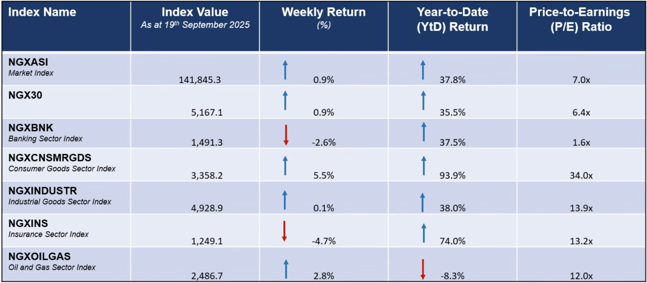
Equities Market – Sectorial Performance
Weekly Performance of Sectorial Indices
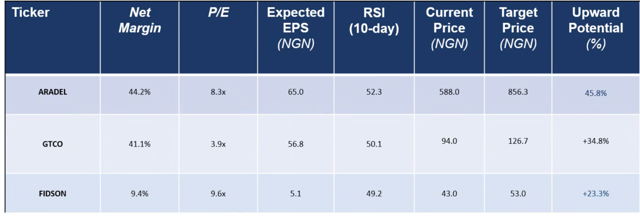
Stocks Top Picks for the Week
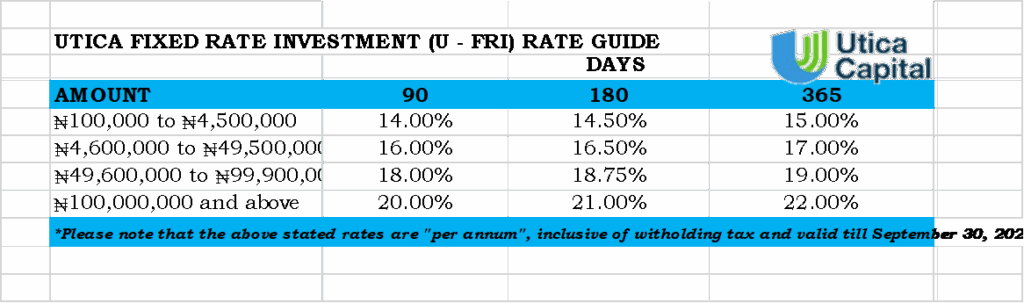
Fixed Income Opportunities for the week